Showing posts with label unit 1. Show all posts

Thursday, August 27, 2015

Activity 1.2.3 - Inferring Information About a Speaker Using Voice

Activity 1.2.3 -

Inferring Information About a Speaker Using Voice


The following is one person’s description of pizza. What inferences can you draw about Speaker 1 based upon the speaker’s voice? Write your inferences in the graphic organizer that follows. Cite details of the speaker’s voice that led you to that conclusion.

Speaker 1: Eating pizza is rather like embarking on a transcontinental excursion. You embark on the journey without being quite certain of what you will encounter. A well-made pizza contains the aromatic essence of fresh basil, oregano, and garlic that beckon invitingly. Once you bite into a perfectly sliced piece of pizza, your taste buds awaken and celebrate. When properly prepared, pizza is an extraordinary culinary creation.
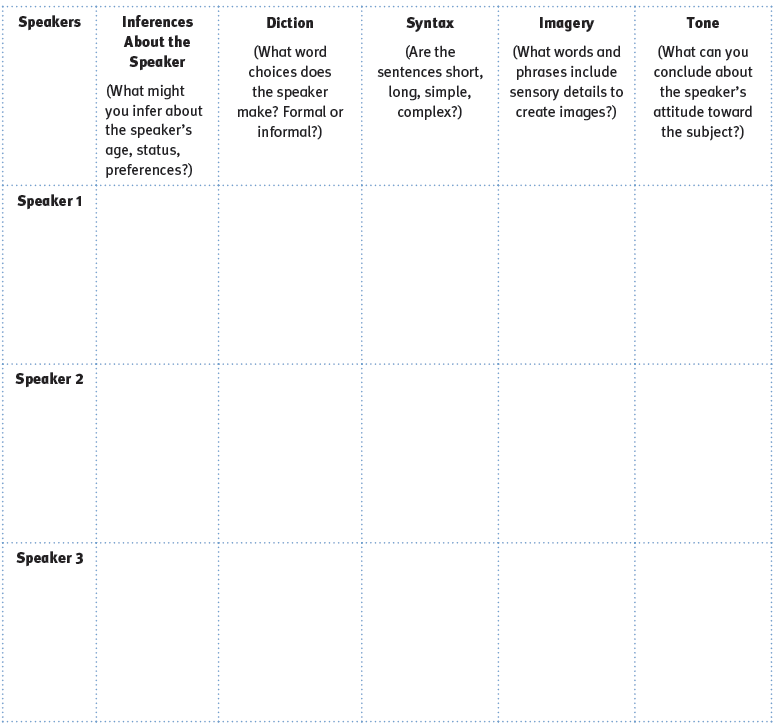

Inferences are justifiable only if they can be supported by textual evidence.

1. Discuss your conclusions about Speaker 1 with another set of partners, comparing the annotations and the inferences you have drawn based upon them.

2. Evaluate how supportable the inferences are based on the evidence you can provide to support your inferences.

3. Rank each of your inferences from “strongly supported by evidence” to “somewhat supported by evidence.” Be prepared to justify your inferences—and your rankings—by explaining how the textual evidence supports your conclusions.


4. Now read the remaining speakers’ descriptions with a partner, highlighting and annotating each passage for the diction, syntax, and imagery that contribute to the voice and tone. Write your annotations in the graphic organizer on the previous page to capture your responses.

Speaker 2: It’s yummy. I like it when the cheese is really gooey. My mom makes it for dinner on the weekends. When it’s too hot, I have to wait for it to cool. Mom says if I don’t wait I will burn my tongue. I like the way pizza smells. When I smell pizza cooking it always makes me want to eat it right up!

Inference about the speaker:_______________________

Speaker 3: As long as not one speck of gross disgusting animal flesh comes anywhere near my pizza, I can eat it. I prefer pizza with mushrooms, tomatoes, and spinach. Goat cheese is especially nice too. A thin whole-wheat crust topped with imported cheese and organic vegetables makes a satisfying meal.

Inference about the speaker:_______________________


Speaker 4: Pizza is, like, one of the basic food groups, right? I mean, dude, who doesn’t eat pizza? Me and my friends order it like every day. We usually get pepperoni, and it’s great when they are, like, covering the whole top! Dude, hot steamy pizza dripping with cheese and loaded with pepperoni is awesome.

Inference about the speaker:_______________________

Activity 1.2.2 - Notes (Right)

Activity 1.2.2 - Notes (Right)


If several different people were asked to describe pizza, you might expect to get a variety of responses. Even though the subject would be the same, the descriptions might be quite different because each person uses a different voice.

Voice is a result of a writer’s or speaker’s use of language, and it may be so unique that it’s almost like a fingerprint: a sign of the writer’s or speaker’s identity. This fingerprint results from three central aspects of how language is used in the text.

Diction—Word choice intended to convey a certain effect
Syntax—Sentence structure; the arrangement of words and the order of
grammatical elements in a sentence
Imagery—The words or phrases, including specific details and figurative language, that a writer uses to represent persons, objects, actions, feelings, and ideas descriptively by appealing to the senses

Wednesday, August 26, 2015

Activity 1,2,1 - Quickwrite (Left)

Activity 1.2.1 - Quickwrite (Left)


Quickwrite:

When you think of pizza, what comes to mind? In your RWNB, write a paragraph describing pizza and showing your attitude toward it. You will come back to this later.

Sunday, August 23, 2015

Activity 1.1.3 - Developing Vocabulary

Activity 1.1.3 - 

Developing Vocabulary


Unit 1 Academic Vocabulary/Literary Terms QHT


Vocab/Term
Q
I have questions
H
I have heard of it
T
I could teach it
strategize/strategies


voice


tone


infer/inference


narrative


narrator


anaphora


denotation


connotation


diction


juxtaposition


foreshadowing


direct quotation


indirect quotation


compound sentence


protagonist


parallel structure


phrase


clause


syntax


prose


transcript


claim


counterclaim


independent clause


dependent clause


analogy


rhetorical appeals


Logos


Ethos


Pathos


Activity 1.1.2 - Essential Questions

Activity 1.1.2 - Essential Questions


Based on your current knowledge, write answers to these questions in your RWNB:

1. What does it mean to “come of age”?

2. How are rhetorical appeals used to influence an audience?

Activity 1.1.1 - Making Connections

Activity 1.1.1 - Making Connections


Let’s read the paragraph below and discuss any terms you don’t know:

As you read about coming of age, you will learn about voice and style, the characteristics that make a writer’s or speaker’s work distinctive. You will evaluate texts and make inferences based on textual evidence. Then you will conduct an interview and write an interview narrative in which you capture the voice of the interviewee.

Unit 1 Overview

Unit Overview


Ninth grade marks many important transitions, beginning the experiences of becoming an adult. In this unit, you will explore the theme of “coming of age” and examine how writers in a variety of texts use stylistic choices to create the voices of characters who are going through life-changing experiences. Along the way, you will study a novel independently, conduct interviews, analyze arguments regarding the value of post-secondary education, and examine the complex relationship between an author’s purpose, his or her audience, and the ways in which he or she appeals to readers. By the end of the unit, your academic “coming of age” will be marked by a heightened understanding of voice, appeals, and persuasive techniques.